Something significant is happening in the UK home improvement market. The 2026 sustainable home improvement landscape reflects this shift clearly, and the data from NSBRC visitor surveys make the direction of travel unmistakable.
Whether you are planning a complete self-build, a major renovation, or a targeted retrofit, this guide brings together the most important trends, technologies, and policy changes shaping sustainable home upgrades in 2026.
Shifting motivations and the rise of whole-house thinking
Homeowners arriving at the National Self Build and Renovation Centre (NSBRC) in Swindon are more informed than ever, and their priorities have shifted measurably. Energy efficiency and lower energy bills now score above 90% as primary motivations among visitors, a figure that signals a fundamental change in how people think about home improvement.
This is no longer a niche concern for eco-enthusiasts. Whole-house thinking, treating the home as an integrated energy system rather than a collection of separate components, has gone mainstream, even for homeowners who are renovating rather than building from scratch.
90%+cite energy efficiency and lower bills as primary motivations
92%budgeting for higher insulation levels
74%budgeting for airtight homes
73%budgeting for triple glazing windows
Retrofit demand is growing fast; now a third of all enquiries
Retrofit projects upgrading existing homes rather than building new now account for a third of all visitor enquiries at the NSBRC. This is a significant shift from the predominantly self-build focus of previous years, and it reflects both the state of the UK’s aging housing stock and growing homeowner awareness of how much energy existing homes waste.
Urban and semi-urban homeowners are disproportionately represented in this group. Draughty Victorian terraces, poorly insulated postwar bungalows, and energy-leaking housing stock across UK towns are creating a wave of retrofit demand from people who want greater control over their energy use and a meaningful reduction in their running costs without necessarily moving home.
Renovation projects now represent a third of NSBRC enquiries,
a clear sign that the retrofit market is maturing rapidly and that homeowners are
increasingly treating energy upgrades as a serious investment,
not an optional extra.
Low-carbon construction materials are gaining ground in the self-build market.
Among self-builders specifically, material choices are evolving. Timber frame construction and insulated panels remain popular for their speed and thermal performance. But a growing number of visitors are exploring hemp building materials and straw-based construction, natural, low-embodied-carbon alternatives that are increasingly well understood and accessible through specialist suppliers.
How self-builders are choosing between construction methods in 2026
Traditional masonry construction remains the most common choice; familiarity, resale appeal, and widespread availability of trades all keep it dominant. But the picture is changing: over half of NSBRC survey respondents say they are at least considering low-carbon or modern construction methods for performance and sustainability reasons. That is a meaningful shift from even three years ago.
Timber frame constructionFast build speed, excellent thermal performance, well-understood by lenders and insurers. The dominant choice among performance-focused self-builders.>Most popular alternative
Insulated panels (SIPs)Structurally insulated panels deliver high levels of airtightness and insulation in one component. Ideal for achieving Passivhaus-adjacent performance.>High performance
Hemp building materialsHempcrete offers excellent breathability, thermal mass, and negative embodied carbon. Growing interest among eco-focused self-builders.>Low carbon
Straw-based constructionStraw bale and straw panel systems offer ultra-low embodied carbon and exceptional insulation. Niche but growing, with specialist support available.>Ultra-low carbon
Masonry constructionTraditional brick and block remain widely used for their familiarity and resale value. Now increasingly combined with high-performance insulation layers.>Still dominant
What “modern methods of construction” actually means for homeowners
Modern methods of construction (MMC) is a broad term covering any approach that moves away from traditional brick-and-block construction on site. It includes factory-manufactured components, modular systems, and hybrid approaches. The appeal for self-builders is performance consistency and speed; elements of the build are manufactured under controlled conditions, reducing weather dependency and on-site variability. For sustainability, the key benefit is precision: less material waste, tighter tolerances, and better thermal performance as standard.
A note on structural warranties and mortgage availability
Some lenders and warranty providers are still catching up with newer construction methods. If you are planning a self-build using hemp, straw, or a less conventional MMC system, check early with your mortgage provider and structural warranty supplier. The market is more accommodating than it was five years ago, but it is still worth confirming before committing to a method.
Heat pump adoption and sustainable heating systems in 2026
Heat pumps are now the dominant choice for sustainable heating among NSBRC visitors planning new builds and major renovations. An impressive 82% of survey respondents are budgeting for heat pumps or similar low-carbon technologies, a figure that reflects both growing confidence in the technology and the financial incentives now available to support installation.
Heat pumps work by extracting heat from the outside air or ground and concentrating it for use in the home. They are not a new technology; they have been standard in Scandinavia and Germany for decades, but UK adoption has accelerated significantly as the Boiler Upgrade Scheme has reduced the upfront cost barrier, and installer capacity has grown.
The Boiler Upgrade Scheme: what the BUS grant covers in 2026
The Boiler Upgrade Scheme (BUS) provides grants of up to £7,500 toward the installation of eligible low-carbon heating systems, including air source heat pumps, ground source heat pumps, and biomass boilers. The grant is applied directly by the installer and reduces the upfront cost of installation — meaning homeowners pay the net cost rather than claiming a rebate afterwards.
Who qualifies for the BUS grant?
The BUS grant is available to homeowners in England and Wales, replacing a fossil fuel heating system with an eligible low-carbon alternative. Properties must have a valid Energy Performance Certificate (EPC) with no outstanding recommendations for loft or cavity wall insulation. The grant is processed through MCS Certified installers, a requirement, not a recommendation, that ensures both technical quality and access to funding.
Always use an MCS Certified installer for heat pump and renewable energy installations.
MCS certification means the installer has met rigorous training and competency standards,
and it is a mandatory requirement for accessing government grant schemes,
including the Boiler Upgrade Scheme.
The fabric-first approach: why insulation comes before technology
The single most important principle in sustainable home renovation is deceptively simple: fix the building fabric before adding technology. A heat pump installed in a poorly insulated, draughty house will run constantly, deliver disappointing comfort, and produce heating bills that disappoint. The same heat pump in an airtight, well-insulated home will perform excellently, cost less to run, and deliver the genuine energy savings homeowners are looking for.
What the fabric-first approach means in practice
A fabric-first approach prioritises home insulation upgrades, airtight construction, and high-performance windows, specifically high insulation levels, airtight homes, and ideally triple glazing, before any investment in low-carbon technology. The logic is straightforward: reducing the amount of heat the building loses means any heating system, whether a heat pump, biomass boiler, or hybrid system, has to do less work. The result is lower energy bills, better comfort, and a smaller carbon footprint.
The NSBRC’s brand-new Retrofit Zone exhibit is specifically designed to help homeowners understand and plan this approach, with guidance on sequencing upgrades correctly and understanding how different fabric interventions interact.
Whole-home approach vs. piecemeal upgrades: what the evidence shows
Homeowners who take a whole-home approach, planning all improvements together and sequencing them logically, consistently achieve better outcomes than those who make individual upgrades in isolation. This is partly technical (the upgrades interact and amplify each other) and partly financial (a coordinated plan avoids duplicating work or installing systems that need replacing when subsequent upgrades change the building’s performance profile).
The Renovation House at NSBRC
The NSBRC’s Renovation House, sponsored by Good Energy, is a practical, hands-on exhibit demonstrating how renewable technology integration works in a real home context. It is one of the most visited features at the centre for good reason, seeing how solar PV, heat pumps, batteries, and smart controls work together in a realistic setting is far more useful than reading a specification sheet.
Smart home integration for energy efficiency in 2026
Smart home technology has moved from novelty to necessity in the sustainable home improvement conversation. A third of NSBRC survey respondents planning sustainable upgrades are including smart controls and home automation systems in their budgets, and the proportion is growing as the technology matures and becomes more accessible.
The value of smart home integration is not in any individual device; it is in the ability to coordinate heating, hot water, solar generation, battery storage, and EV charging into a coherent whole-home energy system. Done well, this coordination can dramatically reduce energy waste, maximise the value of solar generation, and shift energy consumption to times when it is cheapest and lowest-carbon.
Smart thermostats, zoned heating, and demand response: how they work together
Smart thermostats allow homeowners to control heating remotely, create schedules based on occupancy, and receive feedback on energy use. Zoned heating systems extend this further, so that different areas of the home can be heated independently, preventing energy from being wasted on empty rooms. Demand-response features allow the heating system to respond automatically to signals from energy suppliers or the grid, shifting consumption to off-peak periods when energy is cheaper or cleaner.
Home energy monitoring: the foundation of intelligent energy control
Home energy monitoring systems give homeowners real-time visibility of exactly where energy is being generated, stored, and consumed. This visibility is the foundation of genuinely efficient low-carbon living: you cannot optimise what you cannot measure. When paired with solar PV systems, home battery storage, and EV charging, a good energy monitoring system turns a collection of individual technologies into a coherent home energy control platform.
AI-driven whole-home energy modelling: the near future
The next evolution in smart home integration is AI-driven whole-home energy modelling systems that learn patterns of occupancy, weather, grid pricing, and solar generation to automatically optimise energy use without manual input. This technology is already emerging in early commercial form and is expected to become increasingly mainstream over the next two to three years, making the smart home integration decisions made today even more valuable.
Solar PV systems, home battery storage, and EV charging: the integrated trio
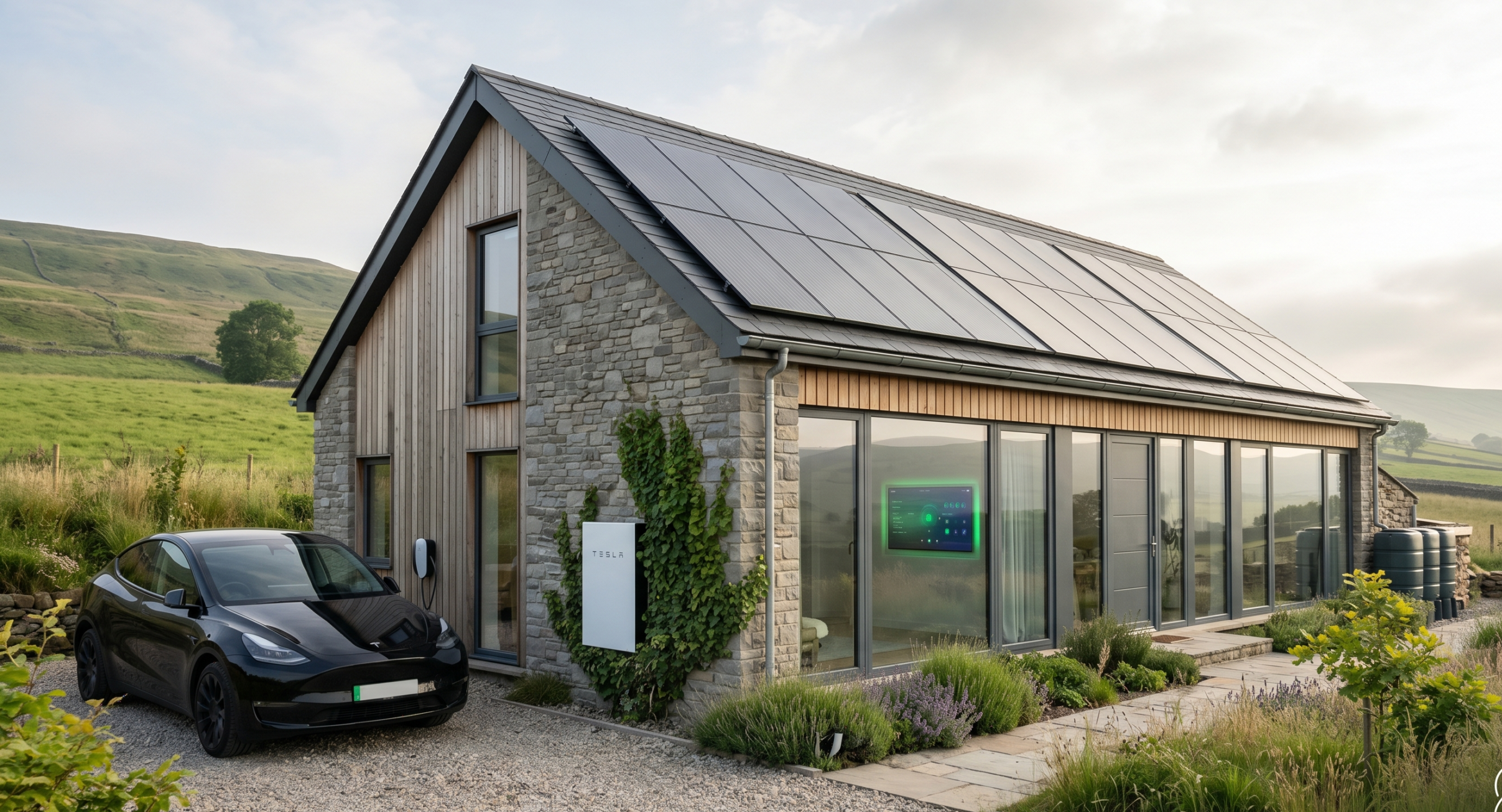
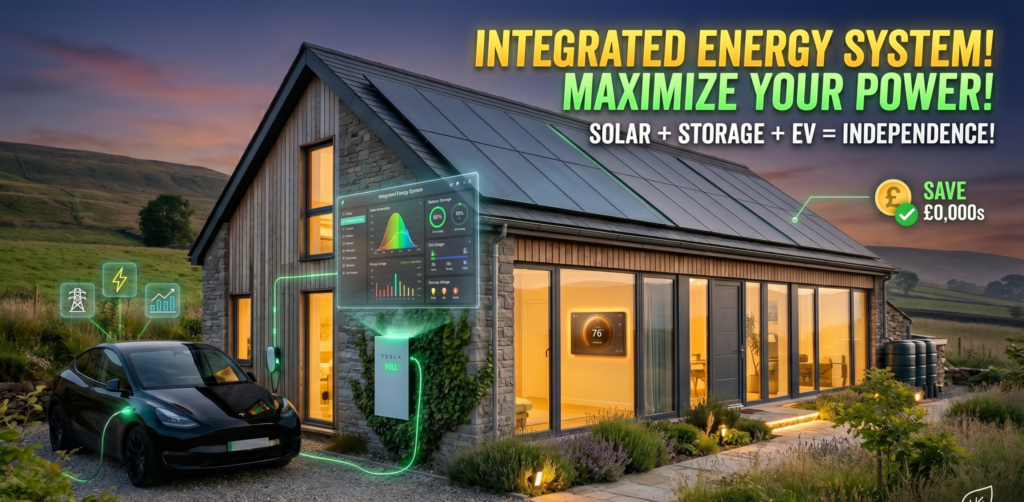
For homeowners investing in sustainable home upgrades in 2026, the combination of solar PV, home battery storage, and EV charging infrastructure represents the most significant opportunity to reduce energy bills and carbon impact simultaneously. These three technologies are more powerful together than any one of them alone.
How solar PV and battery storage work together to cut energy bills
Solar PV panels generate electricity during daylight hours, often more than the home can use in real time. Without battery storage, that surplus is exported to the grid at a low rate. With battery storage, it is retained for use in the evening and overnight, dramatically increasing self-consumption and reducing reliance on grid electricity at peak-rate times. Energy storage solutions like the Tesla Powerwall 3 effectively extend the value of a solar PV investment by ensuring more of what is generated is actually used by the household.
Tesla Powerwall 3: the £750 scheme and why home battery storage matters
Right now, Tesla is offering £750 cashback on the installation of a Powerwall 3, one of the most capable home battery storage systems currently on the market. The Powerwall 3 integrates directly with solar PV systems and smart home controls, making it a natural centrepiece for a whole-home energy integration strategy. It also provides backup power during grid outages, an increasingly valued feature as weather events and grid instability become more frequent considerations.
A note on energy storage solutions
Battery storage technology is evolving rapidly, and prices continue to fall. The Tesla Powerwall 3 is one of several competitive options; others include systems from Givenergy, Sungrow, and SolarEdge. The right choice depends on your solar PV system, energy consumption pattern, and budget. An MCS Certified installer can help you model the options for your specific situation.
The rise of electric vehicles and home EV charging points
Perhaps the most striking figure from the 2025 NSBRC survey is this: 75% of respondents are budgeting for EV charging points as part of their home improvement project. That is not a niche consideration; it is a near-universal one among people planning significant home upgrades. And it reflects a broader shift in how homeowners think about their relationship with energy: the car is becoming part of the home energy system.
Mandatory EV charging points for new homes: what UK regulations require
EV charging infrastructure is now a mandatory requirement for all new homes in England. This is not an optional future-proofing measure — it is a building regulation requirement. For self-builders and developers alike, EV charging points must be included in the design and build. For renovators, installing EV charging now, even before purchasing an electric vehicle, is increasingly considered a standard part of future-proofing a property.
EV infrastructure and its integration with home energy systems
A home EV charger is most valuable when it is integrated with solar PV and battery storage, allowing the car to be charged using surplus solar generation during the day or stored battery energy at a lower cost overnight. Smart chargers can also respond to renewable energy tariff signals, automatically charging when electricity is cheapest and cleanest. This integration turns the EV from a simple transport tool into an additional energy storage asset for the home.
The 2028 mileage-based tax and its potential impact on EV adoption
From 2028, fully electric cars will be subject to a new mileage-based road tax of 3p per mile. For a typical driver covering around 8,500 miles per year, this equates to approximately £255 annually, roughly half the equivalent per-mile cost for a petrol or diesel vehicle. While this introduces a new running cost for EV drivers, the overall economic advantage of electric vehicles over internal combustion engines remains significant, particularly for drivers with home charging capability.
Renewable energy tariffs and cheap EV charging at home
Home EV charging costs vary significantly depending on the electricity tariff a household is on. Good Energy currently offers one of the cheapest EV tariffs available in the UK market, with overnight charging backed by 100% renewable sources from as little as 2p per mile. For homeowners with solar PV and battery storage, combining a smart EV charger with a renewable energy tariff creates the most cost-effective and lowest-carbon charging solution available.
The combination of solar PV, home battery storage, a smart EV charger, and a
renewable energy tariff can reduce the effective cost of EV charging close to zero and,
in some cases, charge the car entirely from energy generated on the roof.
Planning permission reform: unblocking the biggest bottleneck in home improvement
Year on year, NSBRC survey data consistently identify planning permission as the single largest barrier to home improvement projects in the UK. The delays, uncertainty, and complexity of the planning system have stalled countless self-build and renovation projects and frustrated homeowners who want to improve their properties but cannot navigate the process efficiently.
What the 2025 planning reform measures mean for homeowners
The Government’s November 2025 budget announcement included planning reform measures specifically intended to speed up the planning system. The practical impact on individual home renovation projects will take time to become clear, but the direction of intent is positive. Faster determination periods, clearer guidance for certain categories of sustainable home upgrades, and reduced bureaucratic friction are among the anticipated benefits.
What homeowners can do now while reforms take effect?
Practical planning permission for home renovation projects still requires preparation and patience. The most consistent advice from NSBRC technical experts is to engage with your local planning authority early, use a planning consultant familiar with your area for anything beyond straightforward permitted development, and not to assume that national policy changes translate immediately into local decision-making. Pre-application advice from local authorities, often available for a modest fee, can significantly reduce the risk of a refused or delayed application.
Permitted development rights for sustainable upgrades
Many sustainable home upgrades, including solar PV installation, heat pump installation (subject to conditions), and certain extensions, fall within permitted development rights and do not require formal planning permission. Understanding what you can do without permission, and what needs an application, is one of the most valuable pieces of knowledge a homeowner can acquire before starting a project.
Government schemes shaping sustainable homes in 2026: Future Homes Standard and Warm Homes Plan

Two major policy frameworks will define the trajectory of sustainable home building and renovation in the UK over the coming years. Both have been anticipated for some time, and 2026 is expected to bring greater clarity on their implementation.
The Future Homes Standard: what it means for new build homes
The Future Homes Standard will require all new homes in England to be highly energy efficient and low-carbon, with significantly tighter building regulations than currently apply. New homes built to the standard will be future-proofed for low-carbon heating systems and will not require retrofit upgrades to meet forthcoming energy targets. The precise implementation timeline has been subject to revision, but 2026 is expected to deliver the definitive final standard that housebuilders and self-builders will need to plan around.
Future Homes Standard and self-build: what changes for individual builders
Self-builders will be subject to the Future Homes Standard in the same way as volume housebuilders. This means that homes consented or commenced after the implementation date will need to meet the new energy efficiency standards, which align closely with what the most performance-focused self-builders are already building. For those already planning to Passivhaus or high-specification standards, the transition will be straightforward. For those expecting to build to the minimum specification, the requirement to install EV charging points, high-performance insulation, and low-carbon heating will require more planning.
The Warm Homes Plan: £13.2 billion for existing home retrofit
The Warm Homes Plan represents a £13.2 billion Government commitment to improving the energy efficiency of existing homes across the UK. The plan targets the millions of homes currently wasting energy through poor insulation, inefficient heating systems, and outdated building fabric — and aims to reduce energy bills, cut carbon emissions, and improve the comfort and indoor air quality of the existing housing stock.
What the Warm Homes Plan means for homeowners planning a retrofit
Details of eligibility and specific funding mechanisms are still being finalised, but the ambition of the plan is clear: energy-efficient homes UK-wide, delivered through a combination of grants, loans, and support for trusted installers and retrofit supply chain development. Homeowners considering retrofit projects should stay informed as details emerge — and should not delay energy efficiency improvements while waiting for government support that may or may not be applicable to their specific circumstances.
The direction from government policy is unambiguous: homes will need to be more energy efficient, and fabric-first principles will become standard requirements rather than optional best practice. The self-build market continues to set the quality benchmark that volume developers struggle to match, and homeowners must work with professionals who genuinely understand how to deliver high-performance, low-carbon homes.
Who is renovating in 2026? Consumer insights from NSBRC visitors
Understanding who is driving sustainable home improvement demand and what motivates and concerns them helps paint a fuller picture of where the market is heading. NSBRC visitor data provides one of the most detailed windows into real homeowner attitudes available in the UK market.
What motivates homeowners to invest in sustainable home upgrades
The majority of self-builders and renovators visiting NSBRC are aged 55 to 74, and their motivations are overwhelmingly practical rather than ideological. These are people planning their forever home or undertaking what may be the last major renovation of a property they intend to live in long-term. Long-term comfort, lower running costs, and the desire to build or retrofit a home that truly suits their needs are the dominant themes.
Build to personal preferences, lower energy bills, greater energy control, reduced carbon impact, better comfort, and indoor air quality
Key barriers and concerns for homeowners in 2026
Equally important as what drives people toward sustainable home improvement is what holds them back. These barriers are consistent year on year and point to where support, guidance, and better market infrastructure are most needed.
Addressing the knowledge and confidence gap
The knowledge gap is one of the most consistently cited barriers and one of the most addressable. Homeowners who feel equipped with the right information to make good decisions about their home are significantly more likely to proceed with sustainable upgrades. This is why independent, commercially unbiased advice, the kind available at NSBRC, is so valuable: it helps homeowners cut through marketing noise and understand what will actually deliver the outcomes they are looking for.
The retrofit disruption concern: what it really means in practice
Perceived disruption during retrofit projects consistently appears in the barriers list. For many homeowners, particularly older ones upgrading a property they are already living in, the prospect of construction noise, dust, temporary loss of heating, and contractors in the home for weeks is a genuine deterrent. What helps is clear upfront planning, a trusted contractor, and a realistic timeline. Homeowners who have been through retrofit projects consistently report that the disruption was less than they feared, and that the improvement in comfort and running costs was greater than they expected.
Case studies: real homes, real sustainable results
Abstract statistics only tell part of the story. These three case studies from NSBRC visitors demonstrate what sustainable home improvement actually looks like in practice — across very different property types and starting points.
Bungalow renovation: from damp and draughty to EPC rating A
A 1960s bungalow that was damp, mouldy, and chronically cold was extended and completely transformed, achieving an Energy Performance Certificate (EPC) rating of A in the process. The project demonstrates what a whole-home approach can achieve even in a property with significant performance deficits, and how an energy-efficient bungalow can provide exceptional comfort at dramatically lower running costs.
Breathtaking five-bedroom timber frame home exceeding energy standards
A self-build timber frame house design that not only exceeds current energy efficiency building regulations but does so with a distinctive, personalised design that reflects exactly what the owners wanted. An outstanding demonstration that eco-friendly home design and architectural individuality are entirely compatible and that the self-build route consistently delivers quality that volume developers cannot match.
Victorian terrace eco renovation achieving Passivhaus EnerPHit certification
A Victorian terrace extension and eco retrofit that achieved Passivhaus EnerPHit certification, one of the most rigorous energy performance standards available for existing buildings. The project demonstrates how multiple retrofitting methods can be combined to deliver exceptional performance while respecting the character of a traditional townscape. A model for the millions of Victorian and Edwardian terraced homes across UK cities that represent the greatest retrofit challenge and opportunity.
What these case studies have in common
Each of these projects achieved exceptional results through careful planning, a whole-home perspective, and the right professional expertise. None of them followed a simple formula; each required understanding the specific opportunities and constraints of the property in question. This is precisely why independent, expert advice is so central to getting sustainable home improvement right.
Visit the NSBRC for independent homebuilding advice and support
The National Self Build and Renovation Centre is the UK’s only permanent, independent venue dedicated to providing homebuilding advice and support. Located at Junction 16 of the M4 in Swindon, it is free to visit and draws homeowners, self-builders, and renovators from across the UK.
What you will find at the NSBRC
Educational exhibits covering everything from timber frame construction to heat pump installation, including the Renovation House sponsored by Good Energy and the new Retrofit Zone. A Trade Village with over 200 exhibitor displays from suppliers and specialists across every area of home building and renovation. Technical experts available on the helpdesk for one-to-one advice. Regular homebuilding seminars, home renovation workshops, guided tours, and construction exhibitions, or simply drop in at your own pace and explore.
Upcoming events and seminars at NSBRC in 2026
NSBRC runs a comprehensive programme of homebuilding seminars and guided events throughout the year, covering topics from planning permission and sustainable construction methods through to smart home integration and renewable energy systems. These events bring together technical experts from across the industry in a format designed for homeowners rather than professionals — practical, honest, and commercially unbiased.
A note on the value of independent advice in a crowded market
The sustainable home improvement market is growing fast, and with it comes a proliferation of commercial interests eager to sell solutions. Independent venues like NSBRC exist to help homeowners cut through this noise, providing access to a wide range of suppliers and technologies alongside genuinely unbiased guidance on what will actually deliver the outcomes being sought. It is a resource that any homeowner planning a significant project would be well advised to use before committing to a design, a contractor, or a technology system.
Frequently asked questions about sustainable home improvement in 2026
What are the biggest sustainable home improvement trends in 2026?
The dominant trends are whole-house retrofit thinking, heat pump adoption supported by the Boiler Upgrade Scheme, smart home integration combining solar PV, battery storage, and EV charging, and growing use of low-carbon construction materials in self-build. Planning reform and two major government schemes — the Future Homes Standard and Warm Homes Plan — are shaping the policy environment for both new builds and existing home upgrades.
What is the Boiler Upgrade Scheme, and how much can I get?
The Boiler Upgrade Scheme (BUS) provides grants of up to £7,500 toward the installation of eligible low-carbon heating systems in England and Wales, including air source heat pumps, ground source heat pumps, and biomass boilers. The grant is applied through your installer at the point of purchase. You must use an MCS Certified installer to access the scheme, and your property must have an EPC with no outstanding recommendations for loft or cavity wall insulation.
What is a fabric-first approach to home renovation?
A fabric-first approach means prioritising improvements to the building envelope insulation, airtightness, and high-performance windows — before installing renewable energy or low-carbon heating technologies. The principle is that reducing heat loss first makes any heating or energy technology you install work harder and cost less to run. It is the most reliable way to achieve genuine energy bill savings and whole-home comfort improvements.
Are EV charging points mandatory for new homes in the UK?
Yes. EV charging points are now mandatory for all new homes in England as a building regulation requirement. Self-builders and developers must include EV charging infrastructure in new builds. For homeowners renovating existing properties, installing EV charging is increasingly considered standard future-proofing, even before purchasing an electric vehicle.
What is the Warm Homes Plan, and will it help me with retrofit costs?
The Warm Homes Plan is a £13.2 billion Government investment aimed at improving the energy efficiency of existing homes across the UK through grants, loans, and supply chain support. Details of eligibility and specific funding mechanisms are still being finalised as of early 2026. Homeowners considering retrofit projects should monitor announcements for schemes applicable to their circumstances, but should not delay beneficial upgrades solely while awaiting government support.
How do I find a trusted installer for heat pumps or solar PV?
Look for MCS Certified installers. This is the industry standard certification scheme for renewable energy and low-carbon heating installations in the UK. MCS certification means the installer has met training and competency requirements, carries appropriate insurance, and provides the guarantee backed by the consumer protection scheme. It is also a mandatory requirement for accessing government grants, including the Boiler Upgrade Scheme. The MCS database allows you to search for certified installers in your area.
Information correct at time of publication. Government scheme details, grant values, and planning regulations are subject to change. Always verify current eligibility and conditions before making financial commitments. Visit the NSBRC for the most current independent guidance.