What does HVAC stand for?
HVAC, or Heating, Ventilation and Air Conditioning, is a general term used to describe your heating and cooling system as a whole. Although the world of HVAC may seem daunting, that doesn’t have to be the case for homeowners. Let’s break down the basics.
In this post, we’ll be covering:
-
What a home HVAC system is
-
HVAC terms all homeowners should know.
-
Elements comprising an HVAC system
-
Types of HVAC systems
-
How HVAC systems work
-
HVAC codes and standards
-
Which is the best HVAC system for you
-
What is the price of a new HVAC system
-
How to install an HVAC system
-
How to hire an HVAC contractor
-
How to become an hvac tech
-
List of Other HVAC Guides
Let’s get started.
What does HVAC mean?
HVAC:
Heating, Ventilation And Air Conditioning It’s an initialism that is short for heaters and coolers. A home HVAC system is a full comfort system for your house that heats and cools, plus offers better indoor air quality and humidity control. HVAC systems are available in various types. They can be made of a number of parts including air conditioners, heat pumps, air handlers, furnaces, air cleaners and humidifiers.
What is energy efficiency in HVAC, which are its criteria I need to know when thinking about a new HVAC?

Heating and air conditioning systems today are more efficient than ever. But there’s an alphabet soup of acronyms that you need to understand in order to make the best choice for your energy efficiency needs.
The better an HVAC system performs, the easier it can be to cut down on your energy usage and spend less on utility costs. For all these ratings, the higher the number, the more efficient the unit.
AFUE
AFUE means Annual Fuel Utilization Efficiency and is a rating applied to how efficiently a gas furnace or boiler uses fuel., kicking heat up your chimney that is energy you paid for the fuel to create… yes?Upon being rungs through some mathematical equations Steam Heating came back with an average of 65% and Hot Water at 80%- that’s what they deemed useful. An AFUE rating in presented as a percentage – it represents how much fuel you used goes towards some type of combustion process while the rest just gets tossed away or lost via burning. Ninety-seven percent AFUE, for example, means that 97% of the fuel burned is directly heating your home.
HSPF2
HSPF2 is abbreviation for Heating Seasonal Performance Factor. This rating only applies to heat pumps and measures the efficiency of a heat pump when it’s cold outside and you need your home warmed. This level of energy efficiency has been recently upgraded.
SEER2
SEER2 is abbreviated form of seasonat Energy Efficiency Ratio. The “2” comes from when the efficiency standards were overhauled. SEER2 quantifies the AVERAGE cooling efficiency of a central air conditioner or heat pump over a range of temperatures, from 65 to 104 degrees F.
EER2
Like SEER2, EER2 provides a means of expressing cooling machine performance at a single operating point and standardizes performance information for heat pump and A/C equipment. This criterion has been recently revised based on EER. For those who reside in a hot climate, an increasingly important heating and cooling system rating than the SEER2 of an AC unit or heat pump is its EER2.
BTU
Note: BTU is British Thermal Unit. One BTU is a measurement of heat energy. More precisely, a BTU is the amount of heat needed to raise (or lower) one pound of water by one degree Fahrenheit. That means in general, if the spaces you need to cool or heat are larger, you’ll probably want an HVAC unit with a higher number of BTUs. Collaborate with an HVAC specialist to find what size is best for your space.
Check out our guide to HVAC metrics for more information.
Another acronym you might encounter involves sound intensity. dB is an abbreviation for decibel, a measure of sound intensity. Trane outdoor units will have the decibel level written indicating it in dBa in the unit manual. dBa is the sound that the human ear can hear.
What’s Inside An HVAC System?
An HVAC is composed of more than one part. It’s a combination of several units and parts, inside and outside your home, all working together to do different jobs in order to deliver total home comfort. Though an HVAC system can include many other elements, here are some of the things you’re likely to find in yours and what they do:
Air conditioner
A central air conditioner works by removing heat and humidity from the inside of your home and transferring it outside. With the right central air conditioning system, you can get relief from even the most sweltering of days. Remember to follow your routine air conditioner service if you want to keep the system in tip-top condition.
Single Stage, 2-Stage & Variable Speed Central air units are available. Check out the best performing Trane central air conditioners to help you choose the perfect unit for your home.
Heat pump
Despite the name, a heat pump can both warm your home and cool it. Heat pumps circulate refrigerant to absorb, carry and release heat — a process you can reverse based on whether you need heating or cooling. Heat pumps powered by electricity are cleaner than heating with fossil fuel combustion.
Heat pumps are offered as single-stage, two-stage and variable-speed systems. Check out Trane’s top-rated heat pumps.
Furnace
While air-source heat pumps use electricity for heating (and cooling), furnaces generate heat by burning a fuel like natural gas or propane. They then circulate that heat throughout your house, raising the temperature indoors.
There are single-stage, two stage and also modulating furnaces. Learn about best furnaces.
Air handler
Air handlers distribute both warm and cool air, delivering it to various rooms in your home so you can achieve a higher level of comfort for each specific space. Air handlers are typically combined with heat pumps, but they can also work with an AC system. Discover more about our top air handlers.
Ductwork
Ductwork: A series of either sheet metal or flexible pipes referred to as ducts that move and distribute air from HVAC units such as your furnace, air conditioner, heat pump and air handler. Properly sized or installed ductwork can cause issues as well as leaking ductwork.
Humidifier/Dehumidifier
You may also want to consider a humidification control unit as part of your heating and cooling system. Humidifiers add moisture to dry air in the winter and refresh the quality of air year round. Whole-house dehumidifiers are beneficial for controlling humidity in energy-efficient/appliance-rich homes, as well as in humid climates and those with single-stage AC.
Whole-house air cleaners
Whole-house air cleaners, also known as air purifiers, can be another part of your HVAC system. They’re enhancing your home’s indoor air quality (IAQ), by grabbing allergens, viruses, bacteria and other contaminants before they have a chance to make it into your HVAC system and into your every breathing space. They are a lot more efficient than your typical HVAC air filter.
Read about the top air purifiers.
Whole-house ventilation
What they are: Whole-house ventilation systems ensure a constant exchange of stale for fresh air throughout your home. Mechanical ventilation won’t be necessary for everyone, but it can help in well-sealed homes.
Thermostat
Your home’s thermostat is the control center of your heating and cooling system. Locus of control -This is inside your house (place you remain in), allows to drive the indoor temperature. When you adjust the thermostat, you’re telling your HVAC system whether to warm or cool down your home.
Smart thermostats, take things up a notch: they let you establish personalized temperature schedules, set your humidity levels, adjust and monitor your system anywhere with the Trane Home App, and grant remote diagnostic access to your dealer. Learn about best thermostats.
Boilers
A heating system a burning furnace to heat water is like the heart of the body. This hot water is then circulated through a network of pipes and/or into radiators in order to warm home or commercial building. Boiler systems are prevalent in existing homes as well as older businesses in the Mid-Atlantic and Northeast states. Learn more about these products at the American Boiler Manufacturers Association.
Geothermal heat pump
Instead of the standard air-source heat pumps that we’ve already been talking about, geothermal heat pumps utilize thousands of feet pipe looped underground to tap into the consistent ambient temperature beneath your home. Geothermal systems are pricier than conventional heat pumps up front and need a yard big enough to accommodate the underground system. Learn more at energy. gov.
Radiant heating
A radiant heating system can have many different types of tubes, or panels, under the floor for floors and ceilings (perhaps as wall panel heaters). They’re powered by electricity or water (in a hydronic system) that pushes heated water through the pipes or tubes. Read up on radiant heating.
Types of HVAC systems
Different kinds of HVAC systems. Work with an HVAC pro to figure out which one is right for your new home or system replacement.
Split system
A split-system central air conditioner is the most common type of system in the US. It’s a matched system that consists of an outdoor unit and an indoor unit.
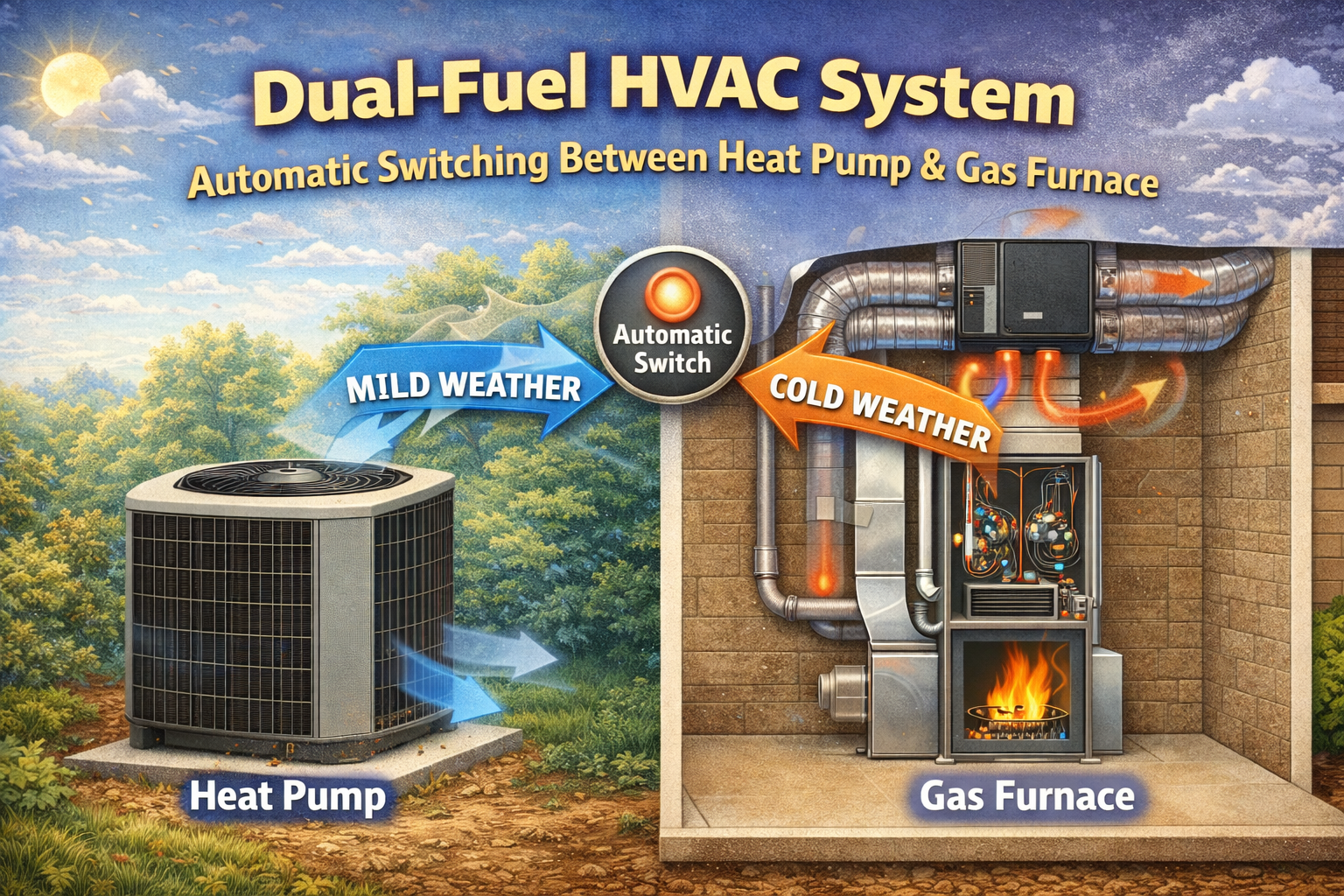
Dual fuel heat pump system
A hybrid system is a dual-fuel system that includes an outdoor electric heat pump and an indoor gas furnace. — The heat pump cools your home in the summer while the furnace moves cool air throughout it. During colder months, you also have dual-fuel heat.
The heat pump/furnace combination is also known as a hybrid HVAC system — it automatically selects the most cost-effective or energy-efficient way to warm your home. Your home is heated by the heat pump throughout the fall and early spring until temperatures reach below 40 degrees. Then the furnace turns on to heat your home and keep you cozy.
Ductless mini-split system
Ductless HVAC systems are perfect for older homes without ductwork, new builds or spaces that could use a little extra help with heating and cooling. A ductless mini-split system consists of an outdoor condenser/compressor unit (referred to as a “mini-split heat pump”) and one or more indoor units.
The main difference between a mini-split and a multi-zone is the number of indoor units they can accommodate: A true mini split system has 1 unit, and a multi-zone ductless system can connect up to 8 indoor units. You can have each at its own temperature or turn it off. You can’t heat and cool at once, though.
HVAC Packaged system
An HVAC unit package is a heating and cooling system contained in one chassis. HVAC packaged units are a great option for smaller homes without space for a larger split system.
Options include:
-
Gas/electric packaged units
-
Heat pump packaged units
-
Dual fuel packaged units
-
AC packaged units
The right HVAC system for your home will vary by the size of your home, the climate in which you live, if any existing ductwork is already in place and whether or not you want to save on energy costs. To get the best value and performance of a new heating cooling system, select HVAC contractors who are skilled at installing ALL brands of heating and air conditioning units.
How do HVAC systems work?
The purpose of your home heating and air systems is to provide you with ideal comfort within your Paddington home. This requires putting an entire system together out of the most basic components — air conditioner/furnace/heat pump, air handler, ductwork, thermostat.
After you’ve identified the ideal HVAC for your home and had it installed, you’re going to use your thermostat to manage the temperature inside. The heating and cooling system in your home pumpkinseed ears What happens: When it’s time to change the temperature of the air, the thermostat will send a message to your house’ heating/cooling/SYSTEM. That newly heated or cooled air will then be sent throughout your home with the aid of ductwork, or an air handler. If your home is equipped with a ductless system, refrigerant lines will facilitate airflow through the system.
Heating and cooling systems are available as gas or electric, but you will find many are all electric now. The most common exceptions are furnaces and boilers, which typically only come as gas or oil-burners.
HVAC Codes and Standards
HVAC for Residential Use in the US Any residential HVAC equipment installed in the US must meet specific standards and codes. This is for building safety, and your safety, and to make sure units are as efficient as they say they are. Codes are legally mandated, other standards and guidelines have been adopted by convention throughout the HVAC industry.
Examples include:
International Residential Code (IRC)
ACCA Residential Manual Designers System Application 1 category I (non-direct vent) negative, single stage draft gas heating system And, on the other end of it: Air Conditioning Contractors of America (ACCA) Piggy Back Load sizing criteria for use in air conditioning systems using equivalent temperature differential Depending on context?
American Society of Heating, Refrigerating and Air Conditioning Engineers (ASHRAE)
Air Conditioning, Heating and Refrigeration Institute (AHRI)
The personal air conditioning contractor must then also comply with all applicable state and local codes the govern HVAC installation.
Which type of HVAC system is best for me?
The best HVAC system for you will depend on a number of factors: your climate, your budget and how important it is for you to be environmentally friendly. The ideal heating and cooling system for you will also reflect your personal home comfort preferences.
Are you looking for an energy-efficient system? Quiet? Ability to monitor humidity? All of the above? These considerations and preferences will guide the perfect mix of devices for your residence.
Once you know what kind of home comfort system you prefer, set up a call or meeting with a reputable HVAC company. A good HVAC professional can help you design the best system for your home as well as discuss system preferences in relation to your climate. Step 1: Learn about HVAC The first step toward finding the best heating and cooling equipment for your home is to learn what HVAC stands for in the first place, so you’re well on your way!
What is the cost of a new HVAC system?
Your final HVAC replacement cost depends on many variables, including:
The unit(s) you are replacing
It’s all about the size of the units (3-ton ac, 4 ton heat pump, etc.).
HVAC pricing where you live
If you’re adding extra features, such as an air cleaner or humidifier
If you need duct sealing or new duct work
If you need electrical upgrades
What brand you choose
Who you hire
There are also some unit specific cost considerations to factor in.
AC replacement cost
How much is a new AC unit? It depends. There are a variety of factors that will affect how much your air conditioner replacement cost is:
AC system size (3 ton AC unit, 5 ton ac unit, etc.)
Whether it’s single-stage, two-stage or variable-speed
The SEER2 efficiency rating
If you replace your furnace at the same time’s.
The brand you choose
Your overall cost will be more if this is a new central air installation and you haven’t yet put in ductwork or if there is no existing ductwork to modify. For residential Trane air conditioning cost that is based around convenience, it’s hard to beat the XR also. For ductless mini split AC costs, simply visit our page for ductless mini split prices.
Furnace replacement cost
How much does a new furnace cost? As before, that question doesn’t really have an answer since what… The following factors can determine your furnace replacement cost:
Heating capacity in BTUs
Whether it is a one-stage, two-stage or modulating furnace
The AFUE efficiency rating
Or if you upgrade your AC or use a heat pump at the same time
The brand you choose
Contact a Local Trane Dealer for Trane Furnace Pricing Unfortunately, we can’t give you an exact price online; contacting your local dealer is the best way to get a good idea of what it will cost to install.
Heat pump cost
How expensive is it to install a heat pump? We know you’ve heard us say this already, but the answer ultimately depends on your individual situation. Options that may drive the price up of a heat pump installation:
Size of your heat pump (4 ton heat pump, 5 ton heat pump, etc.)
If it’s a single-stage or two-stage, or variable-speed heat pump
The SEER2 and HSPF2 efficiencies
If this is a heat pump swap out or gas furnace to hp conversion
The brand you choose
For pricing in your town see local Trane dealer(s).
Air handler cost
Your air handler cost is equally dependent on the kind of system you want. The cost to install an air handler depends on a few factors such as:
If it has a massager that also has a variable speed motor
If it’s a communicating system
The evaporator coil (all-aluminum or painted all-aluminum)NULL
If you are replacing an existing air handler or furnace
The brand you choose
A heat pump plus air handler would be a normal case of when an air handler is installed. If you’re looking to avoid the need of a costly electrical upgrade or retrofitting, and are considering a gas furnace to heat pump conversion, we’d suggest the 120V Modular Variable Speed Air Handler as one that can be replaced without any changes to your home’s wiring situation.
Also consider an ENERGY STAR®-rated system to receive federal tax credits and local rebates. In the long run, energy savings can reimburse you for your HVAC install. Consider the types of HVAC financing to assist you with payment for your new system, also.
To learn more about how to estimate Trane air conditioner costs or the cost of a Trane furnace and Trane installation, visit our HVAC cost estimator. **This product may be eligible for valuable 10-year Limited Extended Warranty coverage; Ask your dealer for details. >Efficient performance The XR16’s ratings of up to SEER 17.00 and HSPF of up to 9.6 make it an energy-efficient option for heating and cooling your home.
How to install an HVAC system
Getting an HVAC system isn’t one of those things you can DIY, unless you’re an HVAC professional yourself. Though a window or wall unit of AC will work there, installation of a full HVAC is for professionals only. This may be a requirement of local building codes, and if you cut corners to try to save a few dollars by doing it yourself, you’ll void its warranty.
How is an HVAC installation done? For a heating and air system you may have to seal or install new duct work, properly venting a gas furnace, hook up refrigerant lines, charge the unit with refrigerant, plumbing the condensate drain line, wiring of electrical components. Evacuating freon must be done by a licensed E.P.A. tech.
Ductless mini-splits Go ductless with a mini split system Featuring an indoor unit that will be mounted on the wall, floor, or ceiling level and is mounted to the outdoor compressor.
Don’t end up with repair costs and warranty hassles leave the HVAC installations to the professionals.

How to choose the right HVAC company in your area
No background work, no hiring a local HVAC company. The best HVAC unit will perform poorly without a proper installation and regular maintenance. It’s one of the many reasons selecting the right HVAC contractor for your needs is so important. When you are trying to find the best HVAC company near you, look for one that offers comprehensive services and has several teams of trained technicians who can do everything from an AC replacement to complete furnace or air conditioner installation.
Begin by reaching out to friends and family members for referrals of the best HVAC companies they’ve used or, maybe more importantly, heating and air conditioning contractors you’re better off not using. Also, ask them with HVAC brands they recommend. You know what they say – you pay for what you get.
Interview the 13 highly rated heating and cooling contractors for your area.
Read reviews, peruse their websites and examine their Better Business Bureau profile. See how well the company responds to negative reviews or customer complaints. You need a heating and cooling business that’s there when you call for top-tier HVAC repair and regular maintenance and can replace your system with incredible skill.
If you need repairs right away, there are companies that will provide 24-hour service. If you’re thinking about replacing your HVAC, get estimates from a few different installers.
How to become an HVAC tech master
Exploring a career change or know a high school student who is mechanically and tech savvy?
Being an HVAC technician might actually be pretty sweet. The field is growing faster than average, according to the Bureau of Labor Statistics. HVAC technician jobs provide job security, decent pay, and more. All you need to be eligible is a high school diploma or GED.
Then you move to an HVAC certificate. Explore programs near you. Your high school student may be able to do that at a vocational high school. After getting your certificate, you qualify for an HVAC apprenticeship paid, on-the-job training with an HVAC company or union. Also, look to get NATE certification so you can showcase your abilities.
Trane provides 2 ways to the HVAC vocation:
The Trane HV!AC Technician Apprenticeship Program QRSTUV HVAC TECHNICIAN APPRENTICESHIP PROGRAMm
The Trane Trade Warriors program, for veterans
Great if you’d like to join us, but you can also search for HVAC apprenticeships in your area.
Other HVAC Guides You Should Know
A guide to fixing or replacing
If you hear strange noises, smell bad smells, feel uneven temperatures, cycle too quickly, or get high bills, you may need to make repairs.
Your system may need to be replaced if it is old (the age varies by type), needs a lot of repairs, has major parts that break down, uses outdated refrigerants, or makes you feel unsafe.
A way to compare costs, like the cost of a one-time repair, the expected life of the system, the energy savings from a new system, and the “50% rule” idea.
Indoor air quality, the risk of carbon monoxide poisoning from old furnaces, and how well they work in bad weather are all factors that affect comfort and safety.
When to fix (newer systems, small parts, and a history of good care).
When to replace: units that are old, have a broken compressor or heat exchanger, or keep breaking down.
How to get a professional opinion: what to ask, how to get multiple quotes, how to find out how much weight you need, and how to check the warranty.
How to Repair a Furnace
A furnace works with gas, electricity, or oil, as well as burners, heat exchangers, blowers, and flues.
Some common problems with furnaces are that they don’t heat, they don’t heat enough, they cycle too quickly, they make strange noises or smells, and they cost a lot of money.
Homeowners should check the thermostat setting, the power switch or breaker, the filter’s condition, the open registers, and the condensate drain.
Common professional repairs include the gas valve, control board, igniter, flame sensor, inducer motor, and blower motor.
Concerns about safety, such as gas leaks, carbon monoxide, a broken heat exchanger, and when to turn the system off right away.
When to hire a pro and when to do it yourself (you can safely change the filter, set the thermostat, and do simple resets).
To avoid problems in the future, keep the area around the furnace clear, get annual tune-ups, and stick to a filter schedule.
A guide to fixing heat pumps
A heat pump has a refrigeration cycle, a reversing valve, and coils for both the inside and outside.
Some common problems with heat pumps are that they don’t heat or cool, run all the time, ice up the outdoor unit, cycle too quickly, or make strange noises.
Homeowners should quickly check the thermostat’s mode, setpoint, filter, outdoor unit for debris and ice, and breaker.
Some common repairs are fixing the reversing valve, defrost board, fan motors, contactor, capacitor, and leaks in the refrigerant.
Issues with defrosting, such as how it should work, what to do if there is too much ice buildup, and how to tell if it is normal or not.
Low charge, dirty coils, duct leaks, and a thermostat that isn’t set up right are all problems that can make things less efficient.
When is it better to fix something than to buy a new one? (age, condition of the compressor, R-22/old refrigerant)
How to Fix Your AC
The indoor evaporator coil, the outdoor condenser, the refrigerant lines, the blower, and the ducts all work together to make central air conditioning work.
Some signs and possible causes are warm air, weak airflow, leaks, frequent cycling, a frozen coil, and high humidity.
Homeowners can quickly fix problems by checking the thermostat’s cool mode, the filter, the vents, the outside unit, and the drain pan or drain line.
Some common AC repairs include fixing the fan motor, cleaning the coils, cleaning the drain line, fixing refrigerant leaks, and fixing compressor problems.
Handling refrigerant yourself has risks (legal and safety notes, why technicians need to be certified).
When to turn off the system: when the coil freezes, when it makes a loud grinding noise, or when it smells like it’s on fire.
Preventive maintenance includes cleaning the coils, filters, and condensate line, as well as doing tune-ups once a year.
A guide for new HVAC owners to get started
Zones, setpoints, and modes like heat, cool, auto, and fan are some basic HVAC ideas.
Being aware of the specifics of your system, such as its model numbers, type, fuel, and efficiency ratings on labels.
How to set your thermostat correctly, including whether it should be programmable or smart, what temperature ranges to use, and when to set it.
Changing filters, keeping vents clear, and cleaning outdoor units are all simple maintenance tasks that homeowners can do.
What paperwork to keep, such as installation papers, warranties, manuals, and service records.
How often to service each kind of system, like a furnace, air conditioner, or heat pump.
Who to call for what (emergency vs. routine) and what to say when you call.
A guide to HVAC metrics
Important ratings for how well things work
Use SEER2/EER2 to cool down.
HSPF2 for heat pumps that are working.
AFUE for heating systems.
COP and GWP (for people who are more technical or environmentally friendly).
Temperature, humidity range, noise levels in dB, and airflow/CFM are all factors that affect comfort.
Measurements of the quality of the air inside (MERV rating, CADR, CO2 levels, VOCs, and particle sizes).
Terms for load and capacity, like BTUs, tonnage, the Manual J idea, and oversizing vs. undersizing.
Cost per hour, seasonal costs, and other operating cost measures like kWh and therms.
How homeowners can use these numbers to look at quotes and systems side by side.
How to Choose an HVAC Contractor
Why it’s important to pick the right contractor (for performance, safety, warranty, and long-term costs).
What to ask for and what papers to see when it comes to licensing, bonding, and insurance.
NATE, manufacturers, and local trade groups offer training and certifications.
Experience with your kind of system, like heat pumps, ductless systems, high-efficiency furnaces, and controls.
Quotes that raise red flags: no load calculation, only one size available, very low price, and no written scope.
You should ask about sizes, brands, warranties, maintenance plans, permits, and timelines.
Reading reviews and checking references.
Getting and comparing a number of quotes (what a good proposal should include).
The Full Guide to Refrigerants
What refrigerants are and how they work in systems that heat and cool.
R-22, R-410A, R-32, CO2, and other refrigerants are common now and in the past.
Effects on the environment (could cause ozone depletion or global warming).
Changes in the rules, like phase-downs, new low-GWP options, and safety classes A1/A2L/A3.
What kind of refrigerant your system probably uses based on how old it is and what type it is.
What changes in refrigerants mean for repairs and replacements (cost of recharging, availability).
How to deal with it safely and why homeowners shouldn’t add refrigerant themselves.
You should choose systems with newer refrigerants when you buy new equipment so that they will last longer.
Green Guide (HVAC that is good for the environment)
How HVAC changes how much energy is used and how much pollution is released.
Heat pumps with inverters, variable speed blowers, and modulating furnaces are all examples of high-efficiency technologies.
Electricity vs. fossil fuels (heat pumps vs. gas and oil in different climates).
Things that help (smart thermostats, zoning, better duct design, insulation, and air sealing).
The health and indoor air quality benefits of greener systems.
Using solar panels and heat pumps, as well as battery backups, to power your HVAC system.
What to upgrade first and cheap ways to make your home use less energy.
How to read energy labels and certifications, such as ENERGY STAR and programs in your area.
A Guide to HVAC Tax Credits and Rebates
Federal tax credits, state and local rebates, utility incentives, and manufacturer promotions are all types of financial incentives.
Different kinds of equipment that can be used include high-efficiency heat pumps, furnaces, air conditioners, controls, and weatherization measures.
Most of the time, qualification requirements include paperwork, minimum efficiency ratings, and installation standards.
How to find programs in your area, like government websites, utility websites, and help from contractors.
How to get the benefit (forms, receipts, certificates, and deadlines).
Stacking incentives: how loans, credits, and rebates can all work together.
Don’t make these common mistakes: buying equipment that doesn’t meet the requirements, forgetting paperwork, or being late.
How to Keep Your HVAC Air Filter Clean
Filters are important for a number of reasons, including airflow, efficiency, the life of your equipment, and the quality of the air inside.
What kinds of filters are there? For example, fiberglass, pleated, washable, HEPA/whole-home systems, MERV ratings, and what they mean.
How to choose the best filter for your home and system (pets, allergies, and fan strength).
General rules for how often to change filters and things that make it necessary to do so more often.
Step-by-step instructions for changing the filter, including how to find it, how to make sure it’s safe, how to get rid of it, and how to use the airflow arrows.
A clogged filter can make dust, weak airflow, longer run times, and coils freeze.
In some cases, like taking care of filters in ductless mini-splits, media cabinets, and electronic air cleaners.
A Guide to Heat Pumps and Furnaces
The main differences are how they heat, what fuel they use, and how well they work when it’s hot or cold outside.
Heat pumps are good because they can cool and heat, are very efficient, make less pollution, and work best in mild climates.
Furnaces are great because they can make a lot of heat, work well in very cold weather, and have a lot of fuel.
Comparing the costs of running them (based on climate, electricity vs. gas prices, and how often they are used).
Differences in comfort and noise (steady heat vs. hotter bursts, airflow).
When it makes the most sense for each one, based on the area, the current infrastructure, and the goals for sustainability.
Some examples are a home that runs on electricity alone, a gas line that is already there, a property in the country, and grid limits.
A Guide to Hybrid Heat Systems
What do you mean by “hybrid” or “dual-fuel” systems? They are systems that use both a gas furnace and a heat pump and switch between them on their own.
How they work in different seasons and at different temperatures (the idea of a balance point).
Pros: efficiency, comfort, fuel flexibility, and long life.
Best times to use it: when energy prices go up or down, when it’s cold outside, or when you already have a gas furnace.
Setting the thermostat, setting lockout temperatures, and choosing between manual and automatic mode are all ways to control the system.
When putting things together, think about ducts, electricity, gas, and how to connect everything.
When a hybrid is better than a furnace or heat pump that works by itself, and when it isn’t.
A Guide to Financing HVAC
Why it’s common to get a loan for HVAC (high initial cost, need for emergency replacements).
You can pay for things in a lot of different ways, like through loans arranged by contractors, bank or credit union loans, credit cards, PACE or similar programs, or payment plans set up by the company itself.
APR, term length, promotional periods, and deferred interest are all important terms to know.
The pros and cons of each option are cost over time, how quickly you can get approved, and how flexible they are.
How to find out the total cost and the monthly payments.
Getting money together with tax breaks and credits.
Things to watch out for and do (like not using predatory language, looking at more than one offer, and reading the fine print).
How to Get a Heat Pump
There are different kinds of heat pumps, such as ducted, ductless, air-source, ground-source, and cold-climate models.
Basic sizing (figuring out the load, the weather, the insulation in the house, and the state of the ductwork).
SEER2, HSPF2, variable speed, noise ratings, and low-ambient performance are all important features.
Make sure the system will work in your home (with or without ducts, enough power, and zoning needs).
When it comes to brand, model, and warranty, there are a few things to keep in mind.
The quality of the installation (why picking a contractor can be more important than the brand).
How much things cost and what makes them cost more.
Things to think about before you buy.
How to Get a Thermostat
You can get different types of thermostats, like non-programmable, programmable, smart/Wi-Fi, learning, and communicating controls.
The system’s compatibility (single vs. multi-stage, heat pump, dual-fuel, line-voltage vs. low-voltage).
Scheduling, geofencing, remote access, energy reports, sensors, and zoning are all important things to compare.
You might save money on energy and be more comfortable.
Works with smart home devices and voice assistants, among other things.
Basic installation information, such as wiring, C-wire needs, and when to hire an electrician or HVAC technician.
Smart thermostats: things to think about when it comes to privacy and data.
How to Buy a Ductless Mini-Split
What ductless mini-splits are and how they work.
Different ways to set up a system, such as single-zone vs. multi-zone and wall/ceiling/floor cassettes.
Best uses: add-ons, home offices, extra rooms, older homes without ducts, and spot zoning.
SEER2, HSPF2, capacity per zone, noise levels, and the ability to heat in low temperatures are all important specs.
When designing, you should think about where to put the indoor unit, how to route the line set, and how to deal with the condensate.
Quality of installation and appearance (making sure the right size is used for each room, not making things too big, and hiding lines).
Costs per zone that are common and savings that could last for a long time.
Needs for upkeep include cleaning the filter, the coils, and getting professional help every so often.